


This article is for educational and informational purposes only and is not a substitute for professional medical advice, diagnosis, or treatment.
Flu, COVID-19, and RSV vaccines are not one size fits all this fall. Each one has its own eligibility rules, and none of them work quite the same way. The clearest path forward is a conversation with your primary care provider, who can look at your age, health history, and vaccination record together and tell you what applies to you.
Which fall vaccines should adults discuss?
Three vaccines are worth raising at a fall appointment: the annual flu shot, the current season’s COVID-19 vaccine, and the RSV vaccine. Each one targets a different virus, and eligibility depends on your age and health status rather than one blanket rule that applies to every adult. Here is what current guidance says about each one.
What the flu vaccine guidance says
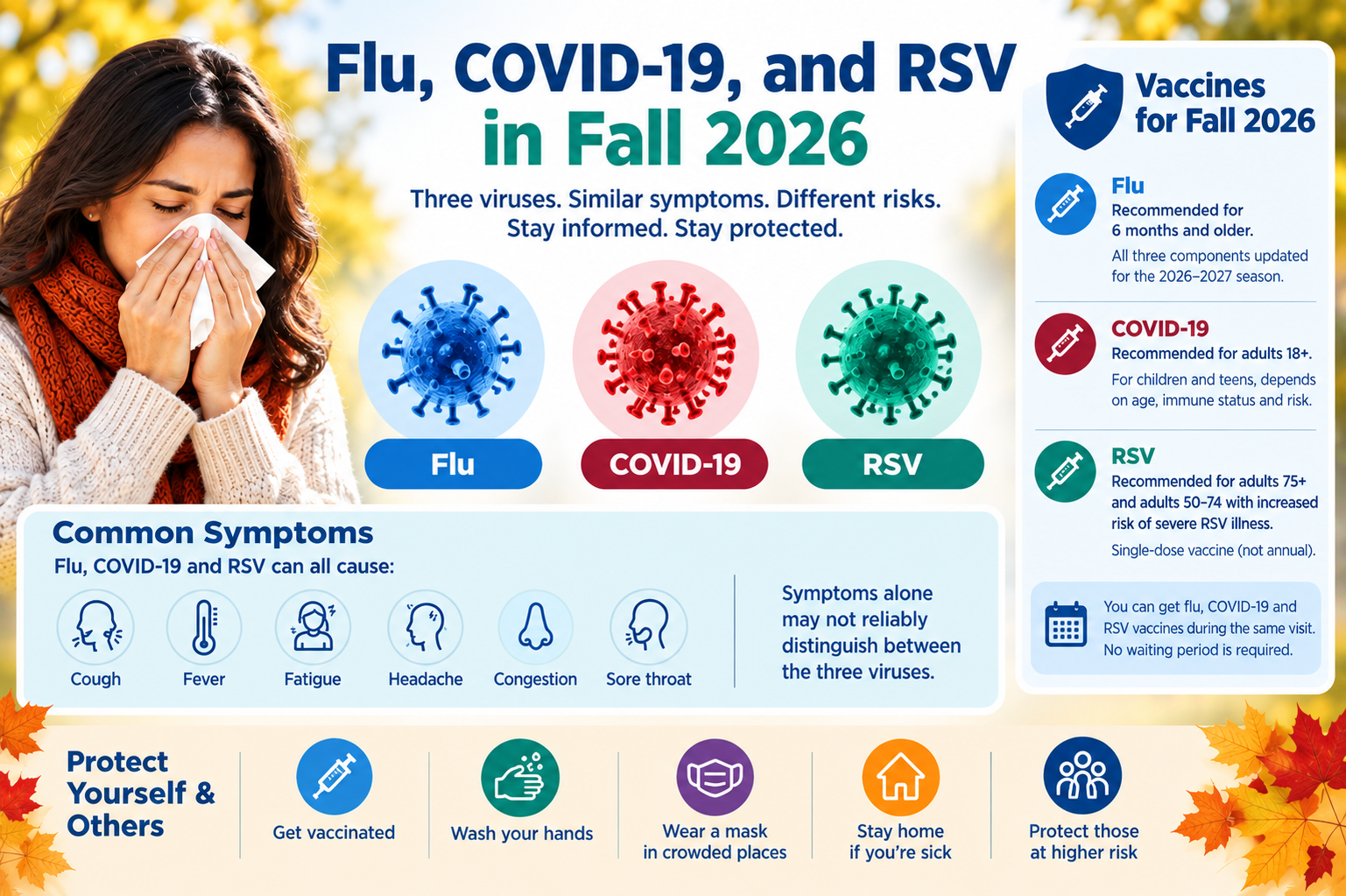
The Centers for Disease Control and Prevention (CDC) recommends annual influenza vaccination for everyone 6 months and older who does not have a contraindication to the vaccine. For the 2026-2027 season, all three virus components used in U.S. seasonal flu vaccines were updated compared with the prior season, including a change intended to protect against an influenza A(H3N2) subclade K virus that spread widely during the 2025-2026 season. Because the formulation changes most years, a flu shot from a previous season does not carry over as protection for this one. Adults 65 and older are preferentially offered a high-dose, recombinant, or adjuvanted vaccine when one is available, since these formulations are built to produce a stronger immune response in older adults.
Source: CDC’s interim clinical considerations for the 2026-2027 flu season.
What the COVID-19 vaccine guidance says
Current CDC guidance recommends the 2026-2027 COVID-19 vaccine for all adults 18 and older. This recommendation carried over from the prior immunization schedule because of legal uncertainty around this year’s advisory process, so the age-based guidance for adults reflects continuity with earlier policy rather than a newly issued recommendation. As with any vaccine decision, CDC guidance frames this as a discussion between a patient and their healthcare provider, one that should weigh personal risk factors, vaccination history, and timing rather than apply the same answer to every adult automatically.
Source: CDC’s 2026-2027 COVID-19 vaccination guidance for adults.
What the RSV vaccine guidance says
CDC recommends RSV vaccination for adults 75 and older, and for adults 50 to 74 who are at increased risk of severe RSV disease. Three vaccines approved by the U.S. Food and Drug Administration (FDA) are currently available for eligible adults: Arexvy (GSK), Abrysvo (Pfizer), and mResvia (Moderna). Unlike the flu shot, RSV vaccination is not currently an annual vaccine. Adults who already received a dose in a previous season do not need another one this year. For adults who have not yet been vaccinated, CDC notes that late summer or early fall is generally the best time, ahead of the point when RSV typically starts spreading in the community.
Source: CDC’s RSV vaccine guidance for adults.
Quick reference
| Vaccine | Who should ask about it | Annual? | Source |
|---|---|---|---|
| Flu | Everyone 6 months and older | Yes, every year | CDC |
| COVID-19 (2026-2027 vaccine) | Adults 18 and older | Current season’s formulation | CDC |
| RSV | Adults 75 and older, and adults 50-74 at increased risk | No, single dose | CDC |
Who may need extra protection?
Age is not the only factor. Certain chronic health conditions raise the risk of severe illness from these respiratory viruses, which is part of why RSV vaccination is recommended for some adults younger than 75. According to CDC’s RSV guidance for adults, conditions that may place an adult in a higher-risk category include:
- Chronic heart disease
- Chronic lung disease, including COPD and asthma
- Diabetes
- A weakened immune system
- Living in a nursing home or other long-term care setting
- Other conditions your provider determines raise your risk of severe respiratory illness
Many of these same conditions come up in conversations about flu and COVID-19 risk as well, since chronic heart disease, chronic lung disease, and a weakened immune system are widely recognized factors in more severe outcomes from respiratory illness generally. If any of the conditions above apply to you, it is worth mentioning at your visit even if you are younger than the standard age threshold for a given vaccine, since your provider may recommend earlier or additional protection based on your specific health history.
Source: CDC’s RSV vaccine guidance for adults.
Aren’t flu, COVID-19, and RSV basically the same thing?
Not quite. Flu, COVID-19, and RSV are three separate viruses, and they can cause overlapping symptoms such as cough, fever, congestion, and fatigue. That symptom overlap is exactly why it can be hard to tell them apart without testing, and it is also why each one needs its own vaccine rather than one shot that covers all three. Being vaccinated against one of these viruses does not protect you against the others, which is the main reason all three are worth raising separately rather than assuming one covers the rest.
Can I get all three at the same visit?
Many adults do discuss getting more than one of these vaccines during the same appointment, since coordinating fall vaccinations in a single visit can be more convenient than scheduling separate trips. Whether that fits your situation depends on your individual health history and the specific vaccines involved, since some combinations may be handled differently depending on age, other medications, or recent illness. This is a question to bring to your provider directly at your appointment rather than something to assume ahead of time.
Can I review vaccines at a primary care visit?
Yes. A primary care visit is the right place to walk through your vaccination history and figure out what still applies to you this fall. Your provider can look at your age, your chronic conditions if any, and what you have already received, then walk you through which of the three vaccines above are worth considering and when. To make that conversation efficient, it helps to bring:
- Your vaccination history, including your most recent flu, COVID-19, and RSV vaccines, if any
- A current list of medications and supplements
- Any chronic conditions you are managing, along with how they are currently treated
- Questions about timing, such as whether it makes sense to space vaccines out or receive them together
Hillside primary care providers can talk through your options as part of your regular care. Explore our primary care services in San Antonio or schedule a visit to start the conversation. Please note that specific vaccine availability can vary by location, so confirm with your local office ahead of your visit.
Questions to ask if you’re pregnant or managing a chronic condition
Vaccine timing and eligibility can shift depending on your trimester or the specifics of a chronic condition, so these are areas where a general guide cannot substitute for a direct conversation with your provider. Pregnancy in particular has its own considerations for some of these vaccines that go beyond the standard adult guidance described above. Questions worth bringing to that visit include which of these vaccines apply at your current stage of pregnancy, whether your chronic condition changes the recommended timing for any of the three vaccines, and whether any of your current medications affect the decision. Bringing these questions in written form can help make sure nothing gets missed during a short visit.
FAQ
Do I need a flu shot every year?
Yes. CDC recommends everyone 6 months and older get a flu vaccine every year, since the vaccine formulation is updated annually to match circulating strains, and immunity from a prior season’s shot is not considered current protection.
Who should get the RSV vaccine?
Adults 75 and older, and adults 50 to 74 who are at increased risk of severe RSV disease, per current CDC guidance. It is a single dose, not an annual vaccine, so if you already received one in a previous season, you generally do not need another this year.
Is the COVID-19 vaccine recommended for all adults this year?
CDC recommends the 2026-2027 COVID-19 vaccine for adults 18 and older. This guidance carried over from the prior season’s schedule due to this year’s advisory process, so it reflects continuity with earlier policy. As with any vaccine, talk with your provider about your personal risk factors and history before deciding.
When is the best time to get a flu shot?
September or October is generally considered the ideal window, so your immunity is strong when flu activity peaks. For a deeper look at timing, see our full guide to flu shot timing.
Can these vaccines be given together?
Possibly. This depends on your individual health history, so it is a question to ask your provider directly rather than assume.
Is the RSV vaccine annual like the flu shot?
No. Under current guidance, RSV vaccination is a single dose. People who already received a dose do not need another one each season.
About the Author