

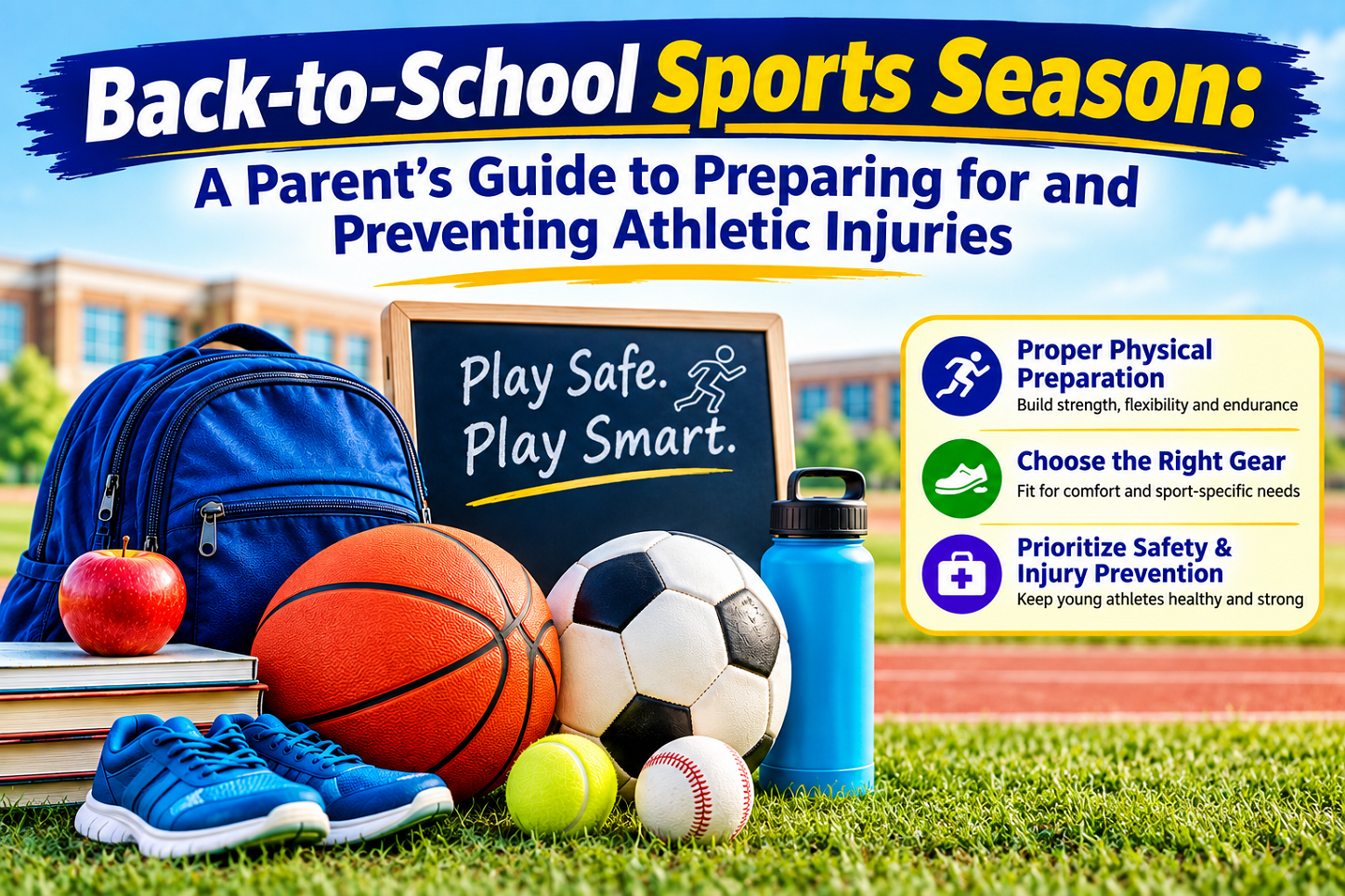

Every sports parent knows the rhythm of the season. The summer conditioning that ramps up in July. The pre-season practices that leave your student athlete exhausted and sunburned. The first game that finally arrives. The mid-season stretch. And somewhere along the way, the injury that nobody was expecting.
This guide walks parents through the full arc of a student athlete’s season, from preparation to prevention to what to do when something happens. At Hillside Medical Group, student athlete care is a coordinated effort across our network, connecting sports physicals, injury evaluation, podiatric care, and physical therapy under one medical group. Knowing how it all fits together is often the difference between a season your child finishes strong and one that ends early.
Before the Season Starts: Sports Physicals and Preparation
Before participating in school athletics, parents should confirm their school district’s pre-participation requirements. Under Texas UIL rules, physical examinations are required at designated points during junior-high and high-school athletics, while an updated medical-history form is required each year. Some school districts require a new physical annually. The examination must be completed and the athlete cleared before participation when a physical is required
A sports physical is not the same as an annual well-child checkup. The sports physical focuses on athletic clearance. The well-child visit covers overall growth, development, mental health, and preventive care. Both matter, and both should happen every year.
For a detailed guide to sports physicals in San Antonio, including UIL form requirements, same-day appointment options, and what to expect at the visit, our sister practice is your best resource. Visit Hillside Primary Care for dedicated sports physical resources, or use same-day appointment options to get this checked off your list quickly.
Sports Injury Prevention: What Actually Works
Prevention is not glamorous, but it is what keeps your student-athlete on the field instead of on the sideline. Most sports injuries in young athletes are preventable when the fundamentals are in place.
Proper conditioning before the season starts
The gap between a summer of relative inactivity and the intensity of pre-season practice is one of the biggest injury risk factors. Gradual buildup matters. Sport-specific conditioning that mimics the actual demands of the sport prepares muscles and joints for what is coming. And core strength, often overlooked, is the foundation of injury resilience across nearly every sport.
The importance of warm-up and cool-down
A structured, sport-specific dynamic warm-up may reduce injury risk and prepare athletes for sudden changes in speed, direction, and intensity. After activity, a gradual cool-down may help the body transition toward rest, although stretching alone has not been shown to prevent every injury or reliably eliminate next-day soreness.”
Rest and recovery are not optional
Young athletes need at least one full day off from organized sport per week. Ideally, they should also take two to three months off from a single sport per year. Year-round specialization in one sport is one of the fastest-growing causes of overuse injuries in student athletes. Sleep, though often overlooked in a busy household, is one of the most underrated recovery tools available.
Proper equipment and footwear
Appropriately fitted protective equipment for the specific sport is non-negotiable. Well-fitting, sport-specific footwear, replaced when it wears out, prevents a significant percentage of lower-body injuries. If your child’s gait or foot structure creates issues, a podiatric evaluation for custom or over-the-counter orthotics can make a real difference.
Hydration and nutrition
Practicing and playing in Texas heat compounds injury risk when hydration is insufficient. Consistent water intake throughout the day, not just at practice, is what protects your athlete. Balanced nutrition supports both performance and recovery. According to the National Institute of Arthritis and Musculoskeletal and Skin Diseases, most sports injuries in young athletes are preventable with attention to these fundamentals.
Common Sports Injuries in Student Athletes
Understanding what you are watching for makes it easier to catch problems early. Here are the injuries you are most likely to encounter across a season.
Ankle sprains and torn ligament injuries in the ankle
The most common injury across nearly every sport. An ankle sprain happens when the ligaments that support the joint are stretched or torn, most often from rolling the ankle inward. According to NIH research, A previous ankle sprain increases the risk of another sprain, particularly when strength, balance, range of motion, and sport-specific function have not been fully restored.”
Knee injuries
ACL tears, MCL sprains, and meniscus injuries show up frequently in cutting and pivoting sports like soccer, basketball, football, and volleyball. Female athletes have a higher rate of ACL injuries in some sports, likely due to differences in anatomy and neuromuscular control. Complete knee ligament tears often need orthopedic surgical evaluation, which sits outside our medical group’s scope. When that is the case, our team coordinates the referral.
Shin splints
Also called medial tibial stress syndrome. Extremely common in runners and any athlete who ramps up training volume too quickly. Shin splints often respond well to rest, gradual return to activity, and a podiatric evaluation for footwear or gait issues that may be contributing.
Growth plate injuries
This is a category unique to student athletes and one every parent should know about. Growth plates are areas of developing cartilage at the ends of long bones. They are weaker than the surrounding ligaments, which means that in a young athlete, a fall or twist that would cause a simple sprain in an adult can instead cause a growth plate injury. Any suspected growth plate injury needs prompt evaluation. If missed or mismanaged, these injuries can affect long-term bone development.
Overuse injuries
Stress fractures, tendinitis, Osgood-Schlatter disease (a common knee condition in growing athletes), and Sever’s disease (affecting the heel in young athletes) are all overuse injuries. They have become more common as young athletes specialize in a single sport year-round with fewer breaks. The signs are usually gradual: pain that starts mild, worsens with activity, and eventually shows up even at rest.
Concussions
A concussion is a traumatic brain injury. If a concussion is suspected, remove the athlete from play immediately and do not allow same-day return. The athlete should be evaluated by a healthcare professional experienced in concussion assessment and should return to sport only through a supervised, stepwise progression after receiving medical clearance. Call 911 or go to an emergency department if danger signs develop, such as worsening headache, repeated vomiting, seizure, increasing confusion, slurred speech, weakness, unequal pupils, inability to wake, or deteriorating consciousness.
The CDC (Centers for Disease Control and Prevention) HEADS UP program provides excellent parent resources on recognizing symptoms and responding appropriately.
Warning Signs a Parent Should Not Ignore
Some symptoms require action today. Some need attention within a day or two. Knowing which is which can protect your child.
Get emergency care right away if your child has:
- Loss of consciousness, even briefly
- Confusion, memory loss, or slurred speech after any head impact
- A visible deformity of a joint or limb
- Severe pain that prevents any movement or weight-bearing
- Numbness, tingling, or coldness in a limb below an injury
- A neck or spine injury
Get same-day medical evaluation if your child has:
- An injury with an audible pop at the moment it happened
- Significant swelling within an hour of the injury
- Inability to bear weight on the injured limb
- A joint that feels loose or gives out
- Pain that is not improving after 48 hours of rest and ice
Schedule an appointment soon if your child has:
- Persistent pain that lasts more than a few days
- Discomfort that changes how they run, walk, or move
- Pain in the same area that keeps coming back
- Complaints about “growing pains” that seem to interfere with activity
A message for parents: Trust your instinct. If something feels wrong to you, get it evaluated. It is always easier to hear that something is minor than to catch a serious injury too late. Same-day appointments are available at Hillside Primary Care, and for foot and ankle injuries, Podiatry of SA can often see young athletes quickly.
The Recovery Pathway: What Happens After Diagnosis
When an injury does happen, recovery is not a single appointment. It is a coordinated process across weeks or months, with different providers doing different things at different stages.
Step 1: Evaluation and diagnosis
Recovery starts with knowing exactly what you are dealing with. At your child’s first visit, your primary care physician takes a history of how the injury happened, examines the affected area, tests range of motion and stability, and compares it to the uninjured side.
Imaging is ordered when needed. An X-ray rules out fractures and, in young athletes, growth plate injuries. If a serious ligament tear is suspected, an MRI may be recommended, which typically requires a referral to an outside imaging center.
For foot and ankle injuries specifically, your primary care provider may refer your child directly to a podiatrist for specialized evaluation.
Step 2: Treatment
For Grade 1 sprains and many Grade 2 sprains, initial treatment can be managed by your primary care provider with rest, protective bracing, and a referral to physical therapy. For foot and ankle injuries, Podiatry of SA handles the specialized care. This includes treatment for fractures that occur alongside ligament injuries, evaluation for chronic ankle instability from repeated sprains, foot pain management, and, when needed, foot diagnostics and surgery.
For serious knee, shoulder, or hip ligament ruptures that need surgical repair, Hillside coordinates the referral to a trusted orthopedic surgeon outside our network and continues to support your child’s care through and after that surgery.
Step 3: Physical therapy and sports injury rehabilitation
This is where sports injury rehabilitation happens, and it is the single biggest factor in whether an injury resolves fully or becomes a chronic problem.
- Physical Therapy of SA provides body-part-specific rehabilitation programs for the most common student athlete injuries:
- Ankle pain treatment for the most common injury site in student athletes
- Physical therapy for knee pain for ligament, meniscus, and post-surgical recovery
- Foot pain treatment and targeted plantar fasciitis treatment for overuse and impact injuries
- Hip pain therapy for hip flexor strains and pelvic injuries
- Back pain treatment for sports-related back sprains and strains
The most important thing for parents to know: consistency with the full physical therapy program matters more than any specific technique. Skipping sessions or stopping early because the pain went away is the number-one reason injuries become chronic in young athletes.
Sprained Ankle Recovery Time for Student Athletes
One of the first questions parents ask after an ankle sprain is how long recovery will take. The answer depends on the type and severity of the injury, the athlete’s symptoms and functional progress, whether other structures are involved, and how consistently the treatment and rehabilitation plan is followed.
Although ankle sprains are often described by grade, these categories provide only general guidance:
Grade 1: Mild Sprain
A Grade 1 sprain involves mild stretching and microscopic injury to the ligament. Many athletes improve within one to three weeks, but return to sport may take longer if pain, swelling, weakness, or balance deficits persist.
Grade 2: Moderate Sprain
A Grade 2 sprain involves a partial ligament tear and typically causes more swelling, tenderness, and difficulty bearing weight. Recovery often takes several weeks and may extend beyond six weeks. A brace, walking boot, or physical therapy may be recommended depending on the examination findings and the athlete’s progress.
Grade 3: Severe Sprain
A Grade 3 sprain involves a complete ligament tear and may cause substantial swelling, instability, and loss of function. Rehabilitation commonly takes several months. Most isolated lateral ankle sprains can be treated without surgery, but orthopedic or podiatric evaluation may be needed when there is significant instability, an associated fracture, a high ankle sprain, persistent symptoms, or failure to improve with appropriate nonsurgical treatment.
Factors that can affect recovery include:
- The location and severity of the ligament injury
- Associated fractures, cartilage injuries, or growth-plate involvement
- The athlete’s age and stage of physical development
- Previous injuries to the same ankle
- Persistent swelling, weakness, stiffness, or instability
- Adherence to bracing, activity restrictions, rehabilitation, and home exercises
- The physical demands of the athlete’s sport and position
Return to play should not be based on time alone. Before returning, the athlete should have minimal or no pain and swelling, near-normal range of motion and strength, restored balance and stability, and the ability to complete sport-specific movements without pain, hesitation, or altered mechanics. The final decision should be made with guidance from a qualified healthcare professional.
Returning before the ankle has regained adequate strength, balance, and function can increase the risk of another sprain and may contribute to chronic ankle instability.
How Hillside’s Coordinated Network Supports Student Athletes All Season
A student athlete’s care over a season is not a single event. It is a series of touchpoints across pre-season, in-season, and post-injury phases. When those touchpoints are coordinated inside one medical group, the process runs smoothly. When they are scattered across disconnected offices, things get lost.
Here is how the pathway works at Hillside:
- Pre-season starts with a sports physical at Hillside Primary Care. Same-day appointments make it easy to get this done in the busy weeks before the first practice.
- In-season injury evaluation happens at Hillside Primary Care with same-day availability. Your child does not wait a week to find out what they are dealing with.
- Specialized foot and ankle care is available at Podiatry of SA. From acute fractures to chronic instability from recurrent sprains, our podiatry team handles the diagnostic and treatment side of lower-extremity injuries in young athletes.
- Rehabilitation is handled by Physical Therapy of SA, with body-part-specific programs that guide young athletes through every phase of recovery, all the way to return-to-play clearance.
- When your child’s injury needs surgery or specialty care, our team coordinates the referral to a trusted orthopedic surgeon or, in the case of a suspected concussion, to an appropriate concussion clinic. Hillside continues to support your child’s care through and after that specialty involvement.
Because these practices sit within the same medical group, your child’s records, imaging, referrals, and treatment plans stay connected across every step. You are not repeating your child’s history at every new office. You are not chasing down test results. Your care team already knows your family.
Return-to-Play: When Is Your Child Really Ready?
“The pain is gone” is not the same as “ready to return to play.” A proper return-to-play decision considers several things at once.
- Pain-free normal activity. Your child can walk, climb stairs, and do daily activities without discomfort.
- Full range of motion. The injured joint moves as freely as the uninjured side.
- Restored strength. The muscles around the injury have been rebuilt through structured physical therapy.
- Restored balance and proprioception. Especially critical for ankle and knee injuries. Proprioception is the body’s sense of where the joint is in space, and rebuilding it is what prevents re-injury.
- Sport-specific movement testing. Your child can perform the actual demands of the sport, whether that is sprinting, cutting, jumping, or throwing, without pain or hesitation.
- Psychological readiness. Your child trusts the injured area and does not favor it or hold back.
- Provider clearance. A medical provider has evaluated your child and confirmed readiness to return.
Rushing any of these steps is how a mild injury becomes a moderate one, and how a moderate injury becomes a chronic problem. Parents, coaches, and athletes all feel pressure to return quickly, especially in a short high school sports season. The best gift you can give your student athlete is patience with the recovery process. A missed game is nothing compared to a lifelong instability that shortens their athletic career.
Take the Next Step
Being a sports parent means walking the line between supporting your child’s love of the game and protecting their health for the long run. Having a coordinated care team means you do not have to walk that line alone. Whether you are getting ready for the first practice, working through an injury, or thinking ahead to next season, our network is here to help.
Schedule a sports physical or evaluation at Hillside Primary Care
Book a podiatry appointment at Podiatry of SA
Learn about Physical Therapy of SA
Or call us directly at (210) 742-6555. We are here to support your student athlete through the full season.
Medically reviewed by the Hillside Medical Group clinical team. Last reviewed: August 2026. This article is for educational purposes and is not a substitute for a clinical evaluation. If your child has symptoms that concern you, contact your provider.
FAQs:
Q1. How can I tell if my child’s ankle injury needs medical evaluation?
Arrange prompt evaluation if your child cannot bear weight, has substantial swelling or bruising, has significant tenderness directly over a bone or growth plate, or if the ankle looks unstable or deformed. An audible pop is more concerning when followed by pain, swelling, weakness, or loss of function. Persistent pain, limping, or symptoms that are not beginning to improve also warrant evaluation.
Seek emergency care for an obvious deformity, an open wound over a possible fracture, severe or rapidly worsening pain, or a foot that becomes numb, cold, pale, or blue. When you are uncertain—especially with a growing child—it is reasonable to have the injury examined.
Q2. Is a sports physical the same as an annual well-child checkup?
No. A sports physical focuses primarily on whether your child can participate safely in athletics and whether any conditions require further evaluation or accommodation. An annual well-child visit provides a broader assessment of growth, development, physical and mental health, immunizations, and preventive care.
Both are important, and they can sometimes be completed during the same appointment if the visit includes all required elements. Confirm your school’s forms and examination requirements before scheduling.
Q3. When can my child return to sports after a torn ankle ligament?
Recovery depends on the location and severity of the injury, whether other structures are involved, and how your child progresses through rehabilitation. Mild sprains may improve within a few weeks, while moderate or severe ligament injuries may require several weeks to several months. Surgical cases generally require a longer recovery.
Return to sport should not be based on time alone. Your child should have minimal or no pain and swelling, near normal motion and strength, restored balance and stability, and the ability to perform sport specific movements without pain, hesitation, or altered mechanics. A qualified healthcare professional should help guide the return to play decision.
Q4. What is the difference between a growth-plate injury and a sprain?
A sprain affects the ligaments supporting a joint. A growth-plate injury affects an area of developing tissue near the end of a child’s bone. Because growth plates are vulnerable during childhood and adolescence, an injury that might cause a sprain in an adult can sometimes injure a growth plate in a young athlete.
The two injuries can produce similar pain and swelling, and some growth-plate injuries may not be visible on the first X-ray. Prompt evaluation is appropriate when pain is located over a growth plate, the child cannot use the limb normally, or symptoms persist despite an initially normal X-ray.
Q5. Should I worry if my child hits their head during a game?
Any head impact followed by headache, dizziness, nausea, confusion, memory difficulty, balance problems, vision changes, unusual behavior, or other possible concussion symptoms should be taken seriously. Remove your child from play immediately and do not allow same-day return. Arrange evaluation by a qualified healthcare professional.
Call 911 or go to an emergency department for danger signs such as a worsening severe headache, repeated vomiting, seizure, increasing confusion, slurred speech, weakness, unequal pupils, inability to wake, or deteriorating consciousness. The CDC’s HEADS UP program provides additional guidance for parents.
Q6. My child says they can “play through” the pain. Should I let them?
Do not encourage your child to continue through sharp, worsening, localized, or function-limiting pain. Stop activity when pain causes limping, weakness, swelling, instability, reduced motion, or a change in technique.
Mild generalized muscle soreness after unfamiliar activity may be different from an injury. However, persistent pain, recurring pain in the same location, or pain that interferes with normal movement should be evaluated. When in doubt, it is safer to pause participation and seek guidance.
Q7. How can I help my child avoid overuse injuries?
Build rest and recovery into the training schedule. Young athletes should generally have at least one to two days each week without organized training or competition and a total of two to three months away from any single sport during the year. These breaks can be divided into shorter periods.
Gradually increase training volume and intensity, avoid sudden workload changes, and encourage adequate sleep, hydration, and nutrition. Age appropriate strength and conditioning, cross training, and early attention to recurring pain can also help reduce overuse injury risk.
About the Author